
What Is Sciatica (Sciatic Pain)? Causes, Symptoms and Treatment
Author: Op. Dr. M. Levent Deniz, Neurosurgery SpecialistLast updated:
Sciatica is not the name of a disease but a symptom describing pain, numbness, tingling or weakness along the sciatic nerve. Its most common cause is lumbar disc herniation; spinal stenosis, spondylolisthesis and compression of the nerve by the piriformis muscle in the buttock also cause sciatica. Because sciatica is not itself a disease, treatment depends on the cause: examination and tests first identify it, then treatment is directed at it. Most patients recover with non-surgical methods; progressive weakness or loss of bladder or bowel control requires urgent assessment.
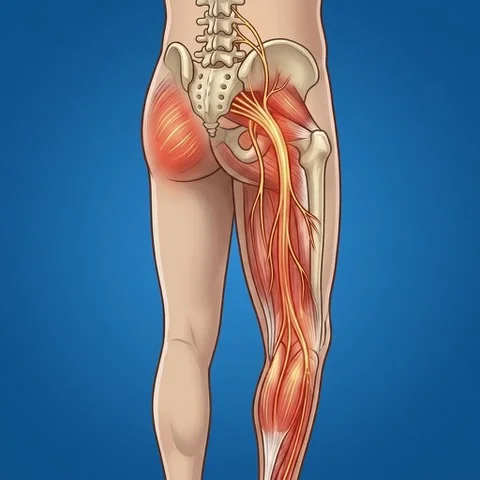
What Is Sciatica?
Sciatica is a clinical presentation of pain, numbness, tingling or weakness along the sciatic nerve as it runs from the lower back into the leg; it is not a diagnosis in itself. It tends to be more severe and last longer than ordinary lower back pain [1].
What Causes Sciatica?
The most common cause is lumbar disc herniation; herniated disc tissue compresses and irritates a nerve root.
- Spinal Stenosis: Causes leg pain and fatigue that worsen with walking and ease when leaning forward or sitting. Details: Spinal Stenosis Treatment.
- Spondylolisthesis: A slipped vertebra narrows the passages through which nerves exit. Details: Spondylolisthesis Treatment.
- Piriformis Syndrome: One of the leading non-spinal causes; the sciatic nerve is compressed in this buttock muscle. Details: Piriformis Syndrome Treatment.
- Other Causes: Hip joint problems, sacroiliac-joint-related pain and peripheral nerve entrapment are less common causes.
What Are the Symptoms of Sciatica?
The most typical symptom is usually one-sided pain that spreads from the lower back through the buttock and down the back of the leg.
- Radiating Leg Pain: Usually one-sided pain from the buttock down the back of the thigh, sometimes reaching the calf and foot. Coughing, sneezing or prolonged sitting may aggravate it.
- Numbness and Tingling: Usually felt in the leg or foot along the same path as the pain.
- Weakness: Difficulty lifting the ankle or toes indicates more severe nerve involvement.
How Is Sciatica Diagnosed?
Sciatica is recognised through the patient’s history and a neurological examination; the main aim is to find the cause of the pain. Its location, pattern of radiation down the leg and what makes it better or worse offer initial clues. The straight-leg-raise test is often positive in sciatica caused by a herniated disc, but cannot establish the diagnosis alone [2]. When needed, the following tests help identify the cause:
- Lumbar MRI: The most important test for showing a herniated disc, spinal stenosis and the state of the nerve roots.
- Computed Tomography (CT): Used to see bone problems and conditions such as vertebral slippage more clearly.
- Electromyography (EMG): Measures the site and degree of nerve damage and is used when the cause remains uncertain.
- Hip MRI and Hip Joint Assessment: Used to investigate hip and surrounding causes, such as piriformis syndrome, if lumbar MRI shows no finding. Not every case of sciatica needs an immediate MRI. Without urgent symptoms, routine imaging is not recommended in the first few weeks [3], because most cases of sciatica improve over time. MRI is requested for urgent symptoms, progressive weakness or pain that persists despite adequate treatment. Not every MRI finding explains the pain; decisions are made by considering the examination and MRI together.
How Does Sciatica Improve?
Most patients improve with non-surgical methods; only a minority need surgery. Because sciatica is not a disease, there is no single treatment for sciatica itself. Treating sciatica means treating the cause of the pain. The details are explained on the page for each underlying condition.
- If Caused by Lumbar Disc Herniation: The vast majority of patients improve without surgery. If needed, interventional pain treatments (algology) such as targeted epidural injection or nucleoplasty are used. Surgery is considered for progressive weakness or pain that persists despite adequate treatment. See lumbar disc herniation treatment for details.
- If Caused by Spinal Stenosis: Exercise, physiotherapy and, if needed, epidural injection are tried first. If walking distance has markedly decreased or weakness is present, surgery is performed to widen the spinal canal. See spinal stenosis treatment for details.
- If Caused by Spondylolisthesis: Non-surgical care or surgery to stabilise the spine is chosen according to nerve compression and whether the spine is unstable. See spondylolisthesis treatment for details.
- If Caused by Piriformis Syndrome: Exercises that stretch the muscle and physiotherapy are the first steps; an image-guided injection into the muscle is used for patients whose pain persists. Measures That Apply Whatever the Cause:
- Movement Instead of Bed Rest: Bed rest does not speed recovery from sciatica [4, 5]. Gentle movement and walking that do not greatly increase pain make it easier to return to daily life.
- Medication: Pain relievers and other medicines have limited effects in sciatica, so medication alone is not the centre of the plan and should be used under medical supervision [6].
How Long Does Sciatica Last?
Most conditions that cause sciatica improve on their own or with simple measures over weeks and months [4]. Pain may recur later. Investigating pain that continues for more than a few weeks speeds recovery.
When Is Surgery Considered for Sciatica?
Surgery is considered for progressive weakness and pain that persists despite adequate treatment. For sciatica due to a herniated disc, early surgery relieves pain faster in patients whose severe pain has lasted weeks; however, most patients managed without surgery recover without an operation, and outcomes in the two groups are similar after one year [7]. For pain lasting months, surgery provides greater benefit than non-surgical management [8].
🩺 Physician’s Insight & Clinical Experience
“The sentence I hear most often in the clinic is, ‘Doctor, I have sciatica.’ Yet sciatica is not a disease; it is the name for a symptom felt in the patient’s leg. In society, sciatica is understood as if it were a single disease and every leg pain is called sciatica. This misunderstanding stops patients looking for the cause: some manage with painkillers alone because they ‘have sciatica’, while others are directed towards treatment that does not suit them. Radiating leg pain comes from a herniated disc in some patients, spinal stenosis in others and, in still others, the piriformis muscle in the buttock despite no finding in the lower back. As a spine surgeon who performs both operations and interventional pain treatments, I first look for the cause in every patient. Once the cause is found and treated appropriately, sciatica is usually a problem that resolves.”
Frequently Asked Questions
Is Sciatica a Disease?
No. Sciatica is a symptom, not a disease. It describes pain, numbness or weakness along the sciatic nerve, with an underlying cause such as a herniated disc, spinal stenosis or piriformis syndrome.
Does Sciatic Nerve Pain Radiate into the Leg?
Yes. Sciatic pain spreads from the buttock down the back of the thigh, behind the knee and sometimes to the ankle as a pulling or electric sensation. The sciatic nerve is the longest and thickest nerve in the body; it runs from the lower back through the buttock to the foot. When compressed by the piriformis muscle, pain begins in the buttock.
How Is Sciatica Treated?
There is no single treatment for sciatica itself; treatment depends on its cause. Examination and tests first determine whether the cause is a herniated disc, spinal stenosis, spondylolisthesis or piriformis syndrome, then care is directed at that condition.
What Helps Sciatic Pain?
During an acute episode, avoiding movements that worsen pain, medication to reduce swelling and heat application are beneficial. In the longer term, regular stretching and injections for selected patients come to the fore.
How Long Does Sciatica Last, and Can It Improve on Its Own?
In many patients, yes: it improves on its own or with simple measures over weeks and months [4]. Weakness, pain lasting more than a few weeks or pain that limits daily life calls for investigation of the cause.
Are Sciatica and Lumbar Disc Herniation the Same Thing?
No. Lumbar disc herniation is a disc condition; sciatica is the leg pain it causes. A herniated disc is the most common cause of sciatica, but not all sciatica comes from one.
How Can I Tell Whether I Have Sciatica, and Which Tests Are Used?
Radiating leg pain, numbness and tingling are symptoms of sciatica; the key is finding the cause. This involves a neurological examination and, if needed, a lumbar MRI, CT or EMG. If lumbar MRI shows no finding, hip-related causes are investigated.
Should I Rest in Bed for Sciatica?
No. Prolonged bed rest does not speed recovery [4, 5]. Gentle movement and walking that do not greatly increase pain are recommended.
When Should an MRI Be Performed for Sciatica?
MRI is requested for progressive weakness, urgent symptoms or pain that does not improve despite adequate treatment; without urgent symptoms, a routine MRI is not needed in the first few weeks [3].
Can Sciatica Cause Paralysis?
Sciatica does not cause paralysis in most patients. However, prolonged severe nerve compression can leave permanent weakness, so progressive weakness should be assessed without delay.
Is There a Sciatica Operation?
No. There is no operation called “sciatica surgery”; surgery addresses its cause—for example, removing a herniated disc or widening a narrowed spinal canal. Most patients do not need surgery.
Which Doctor Treats Sciatica?
Neurosurgery and physical medicine and rehabilitation specialists treat sciatica.
How Much Does Sciatica Treatment Cost?
A definite fee can only be determined after examination and review of imaging; costs vary according to the patient, the cause of sciatica and hospital conditions.
Which Specialist Treats Sciatica in Istanbul?
One of the physicians treating sciatica in Istanbul is M. Levent Deniz, MD, a specialist in neurosurgery.
References
- Konstantinou K, Dunn KM. Sciatica: review of epidemiological studies and prevalence estimates. Spine (Phila Pa 1976). 2008;33(22):2464-2472. PMID: 18923325. PubMed
- Vroomen PC, de Krom MC, Knottnerus JA. Diagnostic value of history and physical examination in patients suspected of sciatica due to disc herniation: a systematic review. J Neurol. 1999;246(10):899-906. PMID: 10552236. PubMed
- Stochkendahl MJ, Kjaer P, Hartvigsen J, et al. National Clinical Guidelines for non-surgical treatment of patients with recent onset low back pain or lumbar radiculopathy. Eur Spine J. 2018;27(1):60-75. PMID: 28429142. PubMed
- Vroomen PC, de Krom MC, Wilmink JT, Kester AD, Knottnerus JA. Lack of effectiveness of bed rest for sciatica. N Engl J Med. 1999;340(6):418-423. PMID: 9971865. PubMed
- Dahm KT, Brurberg KG, Jamtvedt G, Hagen KB. Advice to rest in bed versus advice to stay active for acute low-back pain and sciatica. Cochrane Database Syst Rev. 2010;(6):CD007612. PMID: 20556780. PubMed
- Pinto RZ, Maher CG, Ferreira ML, et al. Drugs for relief of pain in patients with sciatica: systematic review and meta-analysis. BMJ. 2012;344:e497. PMID: 22331277. PubMed
- Peul WC, van Houwelingen HC, van den Hout WB, et al. Surgery versus prolonged conservative treatment for sciatica. N Engl J Med. 2007;356(22):2245-2256. PMID: 17538084. PubMed
- Bailey CS, Rasoulinejad P, Taylor D, et al. Surgery versus Conservative Care for Persistent Sciatica Lasting 4 to 12 Months. N Engl J Med. 2020;382(12):1093-1102. PMID: 32187469. PubMed
- 👨⚕️ Author and medical reviewer of this content: M. Levent Deniz, MD – Neurosurgery Specialist
- ⚠️ Medical Disclaimer: This page is for information only; consult your doctor for diagnosis and treatment.
Appointments & practical information
How do I book an appointment?
You can send your appointment request via WhatsApp, by phone or through the contact form. Briefly describing your complaint and the times that suit you speeds things up; we respond as quickly as possible.
What should you bring to the consultation?
If available, bring your recent MRI and CT images, previous test and surgery reports, and a list of the medication you take regularly. This makes the assessment considerably easier.
What happens at the first consultation?
We listen to your complaints and history, perform a neurological examination and review your existing images together. Treatment options are then planned with you, taking your expectations and lifestyle into account.
Second opinion
If you have been diagnosed or advised to have surgery elsewhere, you can book an appointment for a second opinion with your existing images and reports.
Reach out for your questions and appointment requests. We reply as soon as possible.
Book Appointment