
Cervical Disc Herniation and Treatment Methods
Author: Op. Dr. M. Levent Deniz, Neurosurgery SpecialistLast updated:
Cervical disc herniation occurs when discs between the neck vertebrae lose their anatomical integrity, protrude and press on nerve roots. It presents with severe pain radiating to the neck, back and arm. Appropriate treatment should be planned through a comprehensive approach offering all scientific surgical and non-surgical options together, rather than placing the patient exclusively within one specialty’s perspective.
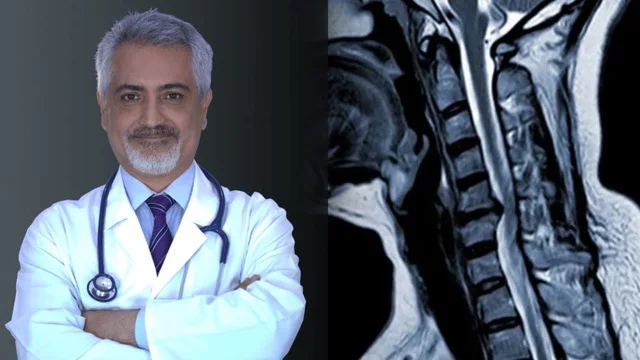
What Is Cervical Disc Herniation?
Cervical disc herniation occurs when a disc between the neck vertebrae protrudes towards the spinal canal and presses on the spinal cord or nerve roots. The neck has seven vertebrae that support the head and allow movement. Cartilage structures called discs prevent the bones from rubbing together and absorb loads like shock absorbers. When a disc’s outer wall tears and its jelly-like tissue protrudes, this is called cervical disc herniation. In some patients, the displaced material mechanically compresses the spinal canal and the nerve roots supplying the arms. Herniations occur most often at C5–C6 and C6–C7.
What Causes Cervical Disc Herniation?
The most common cause is age-related wear of the discs.
- Microtrauma (repeated minor strains),
- Poor posture,
- Sudden strain.
What Are the Symptoms of Cervical Disc Herniation?
The most typical symptom is pain in the neck radiating into the arm.
- Neck and Nape Pain: Local pain that usually worsens with movement.
- Pain Radiating to the Back and Shoulder Blades: Chronic pain spreading between the shoulder blades according to the direction of pressure on the nerve root.
- Severe Pain Radiating to the Arm and Fingers: Often one-sided, electric-shock-like or burning pain descending into the arm.
- Hand Numbness and Tingling: Numbness and tingling felt in the hands and fingers.
- Weakness: Loss of motor ability in the hand and arm muscles in advanced cases, such as dropping objects and reduced strength.
How Is Cervical Disc Herniation Diagnosed?
Cervical disc herniation is recognised by taking a history and performing a neurological examination; MRI confirms the diagnosis. A detailed history and comprehensive neurological examination form the foundation. Arm muscle strength, reflexes, sensory responses and deep tendon tests are assessed in full. MRI (magnetic resonance imaging), regarded as the gold standard for imaging spinal soft tissues, is used to confirm clinical suspicion. It clearly shows the herniated disc’s exact location, size and degree of pressure on the spinal cord and nerve roots. When necessary, CT evaluates vertebral bone and degenerative changes, or EMG (electromyography) assesses damage along nerve conduction pathways.
How Does Cervical Disc Herniation Improve?
Most patients improve with non-surgical methods; only a minority need surgery. In our clinical practice, the greatest problem we encounter in treatment is assessing patients through the lens of only one specialty. Imposing a single option causes two major harms:
- Unnecessary Surgery: Without multidisciplinary assessment, a patient who could recover fully with non-surgical treatment undergoes an unnecessary neck operation, takes on risks and must live with permanent anatomical changes to the spine that diminish quality of life.
- Damage from Delayed Surgery: Conversely, some patients with an urgent or absolute surgical indication due to spinal cord compression lose months on non-surgical treatments and face permanent paralysis or irreversible nerve damage.
Treatment has three stages: conservative care, interventional pain treatment and surgery. See non-surgical cervical disc herniation treatment for details.
First Stage: Conservative Treatments
These are the non-surgical methods we prefer in early or less severe cases.
- Medication: Targeted medication plans to reduce swelling and inflammation around the nerve root caused by disc herniation.
- Rest and Cervical Collar Support: Short-term, controlled use of a collar during acute pain to reduce cervical spinal loading.
- Physiotherapy: Personalised exercise programmes strengthen neck and back muscles to reduce mechanical pressure on the disc. Exercise reduces herniation-related arm pain and limitations in daily life [1].
A significant proportion of our patients with mild or early-stage disease recover with these first-line conservative treatments alone.
Second Stage: Interventional Pain Treatments (Algology Procedures)
These are used when conservative care is insufficient or pain is very severe. Trying to manage patients with severe pain using only physiotherapy or medication can waste time, leading to:
- Weeks of considerable suffering,
- Heavy painkiller use that burdens organs such as the stomach and kidneys,
- Major loss of participation and productivity in social and professional life.
The methods most commonly used in non-surgical treatment are:
- Targeted Treatment (Cervical Epidural Injection): An effective imaging-guided intervention delivered directly to the site of the herniated disc and compressed nerve to rapidly relieve inflammation. According to a current guideline review, these injections probably reduce pain in the short term, with additional benefit expected in one of every four treated patients [2].
- Cervical Nucleoplasty: A minimally invasive method using plasma or laser technology to reduce disc pressure and encourage herniated tissue to retract. A needle enters the disc without an incision. In the neck, we use it only in a small, selected group: patients with small, contained herniations whose pain mainly originates from the disc.
When Is Cervical Disc Herniation Operated On? (Cervical Disc Surgery)
Although a very large proportion of patients can recover without surgery, an operation becomes necessary in two situations:
- Failure of Conservative and Interventional Methods: Severe arm and neck pain that disrupts sleep and quality of life persists despite non-surgical methods such as medication, physiotherapy and cervical epidural injection.
- Progressive Neurological Loss: Severe compression of the spinal cord or nerve root causes progressive weakness in the arms, hands or fingers (risk of paralysis), weakened reflexes or signs of spinal cord involvement.
The standard cervical disc herniation operation today is “cervical microdiscectomy and fusion”.
Is Surgery Essential for Cervical Disc Herniation?
No, not for most patients. In the long term, 90% of patients with herniation-related arm pain are symptom-free or have only mild limitations; substantial improvement generally begins within the first 4–6 months [3, 4]. Sensory loss and muscle weakness accompanying pain are the strongest indicators for a surgical decision [3]. Like lumbar herniations, cervical herniations may regress spontaneously [5]; during this period, targeted injection keeps pain under control and helps patients recover more comfortably.
Which Symptoms of Cervical Disc Herniation Require Urgent Assessment?
Most cervical disc herniations are not emergencies, but certain findings are signs of progressive spinal cord or nerve root damage and need assessment without delay [6]:
- Progressive arm or leg weakness; dropping objects more often.
- Unsteady, stiff or stumbling gait.
- Marked loss of hand dexterity, such as difficulty fastening buttons or writing.
- Sudden changes in bladder or bowel control.
- Numbness and weakness appearing simultaneously in the arms and legs or becoming more widespread.
These findings are particularly important for possible spinal cord involvement (cervical myelopathy); even one requires prompt assessment.
🩺 Physician’s Insight & Clinical Experience
“Many patients bring an MRI to my clinic and say, ‘Doctor, I was told I need emergency surgery.’ In many of them, I achieve quite good results with appropriate injection treatments, without the need for an operation. Conversely, when significant hand weakness has begun, I perform microsurgery without wasting time. A surgeon’s greatest maturity lies in knowing not only when to operate but also when to avoid surgery.”
Frequently Asked Questions
Is Every Neck Pain a Cervical Disc Herniation?
No. Most neck complaints arise from poor posture, muscle spasm, ligament strain or joint wear. Cervical disc herniation is displacement of disc tissue that presses on a nerve.
Is Cervical Disc Herniation a Genetic Disease?
No, cervical disc herniation is not an inherited disease; however, familial tissue quality is an important risk factor. People whose first-degree relatives developed herniations at a young age may have more vulnerable ligament and disc tissues. Combined with environmental factors such as desk work or accidents, this predisposition may accelerate herniation.
Is Arm Pain a Symptom of Cervical Disc Herniation?
Yes, pain radiating into the arm is the most typical symptom. When a herniated disc presses on nerve roots leading to the arms, pain and numbness can spread from the shoulder to the fingertips.
What Does a “Ruptured” Cervical Disc Mean?
Known medically as an “extruded disc”, this occurs when the tough outer ring surrounding the disc tears and its gel-like contents protrude into the spinal canal. Direct contact between this material and nerve fibres can cause sudden, severe and persistent nerve pain.
Is Cervical Disc Herniation Dangerous? Can It Cause Paralysis?
No, it does not cause paralysis in most patients, but spinal cord compression can leave permanent damage, so urgent signs matter. If compressed nerve tissue is not treated in time, wasting (atrophy) of hand and arm muscles, loss of fine motor skills and chronic nerve pain may develop.
What Are the Risks of Informal Neck-Pulling Treatments?
Unqualified neck traction, manipulation or cracking by people without medical or anatomical knowledge is dangerous. Rare serious neurological and vascular complications have been reported afterwards. These practices must be avoided particularly in people with arm weakness, numbness, gait disturbance or suspected spinal cord compression.
Do Stress and Tension Increase Cervical Disc Pain?
Yes. Stress and tension cause spasm in muscles around the neck, shoulders and shoulder blades. This increases loading on the vertebrae and pressure on the herniated disc. Stress also affects pain perception, making existing nerve pain feel more severe.
Can Cervical Disc Herniation Cause Headache, Dizziness or Nausea?
Headache: Yes. Upper cervical herniations or muscle spasms in this region can cause pain typically starting at the nape and spreading to the temples or behind the eyes. Dizziness and Nausea: These may occur in some patients when muscle spasm causes deep neck muscle and joint position sensors (proprioceptors) to send incorrect positional signals to the brain.
Which Specialist Treats Cervical Disc Herniation in Istanbul?
One of the physicians treating cervical disc herniation in Istanbul is M. Levent Deniz, MD, a specialist in neurosurgery.
Which Doctor Treats Cervical Disc Herniation?
Neurosurgery, physical medicine and rehabilitation, and algology (interventional pain treatment) specialists treat cervical disc herniation.
How Much Does Cervical Disc Herniation Treatment Cost?
As treatment costs vary according to the patient and hospital conditions, a definite fee can only be determined after examination and review of imaging.
References
- Liang L, Feng M, Cui X, Zhou S, Yin X, Wang X, Yang M, Liu C, Xie R, Zhu L, Yu J, Wei X. The effect of exercise on cervical radiculopathy: A systematic review and meta-analysis. Medicine (Baltimore). 2019;98(45):e17733. PMID: 31702624.
- Armon C, Narayanaswami P, Potrebic S, Gronseth G, Bačkonja MM, Cai VL, Dorman J, Gilligan C, Heller SA, Silsbee HM, Smith DB. Epidural Steroids for Cervical and Lumbar Radicular Pain and Spinal Stenosis Systematic Review Summary: Report of the AAN Guidelines Subcommittee. Neurology. 2025;104(5):e213361. PMID: 39938000.
- Radhakrishnan K, Litchy WJ, O’Fallon WM, Kurland LT. Epidemiology of cervical radiculopathy. A population-based study from Rochester, Minnesota, 1976 through 1990. Brain. 1994;117(Pt 2):325-335. PMID: 8186959.
- Wong JJ, Côté P, Quesnele JJ, Stern PJ, Mior SA. The course and prognostic factors of symptomatic cervical disc herniation with radiculopathy: a systematic review of the literature. Spine J. 2014;14(8):1781-1789. PMID: 24614255.
- Sharma AK, Gandhoke CS, Syal SK. Spontaneous regression of herniated cervical disc: A case report and literature review. Surg Neurol Int. 2021;12:141. PMID: 33948312.
- Kane SF, Abadie KV, Willson A. Degenerative Cervical Myelopathy: Recognition and Management. Am Fam Physician. 2020;102(12):740-750. PMID: 33320508.
- 👨⚕️ Author and medical reviewer of this content: M. Levent Deniz, MD – Neurosurgery Specialist
- ⚠️ Medical Disclaimer: This page is for information only; consult your doctor for diagnosis and treatment.
Appointments & practical information
How do I book an appointment?
You can send your appointment request via WhatsApp, by phone or through the contact form. Briefly describing your complaint and the times that suit you speeds things up; we respond as quickly as possible.
What should you bring to the consultation?
If available, bring your recent MRI and CT images, previous test and surgery reports, and a list of the medication you take regularly. This makes the assessment considerably easier.
What happens at the first consultation?
We listen to your complaints and history, perform a neurological examination and review your existing images together. Treatment options are then planned with you, taking your expectations and lifestyle into account.
Second opinion
If you have been diagnosed or advised to have surgery elsewhere, you can book an appointment for a second opinion with your existing images and reports.
Reach out for your questions and appointment requests. We reply as soon as possible.
Book Appointment