
Cervical Spinal Canal Narrowing and Its Treatment
Author: Op. Dr. M. Levent Deniz, Neurosurgery SpecialistLast updated:
Cervical spinal stenosis is narrowing of the canal carrying the spinal cord and nerve roots due to age-related degeneration, ligament thickening and disc wear. It causes neck and back pain, numbness in the arms and, later, weakness. Not every narrowing requires surgery: medication, physiotherapy and interventional pain treatments are used when there is no neurological loss; canal-widening surgery is considered when the spinal cord is affected or weakness develops.
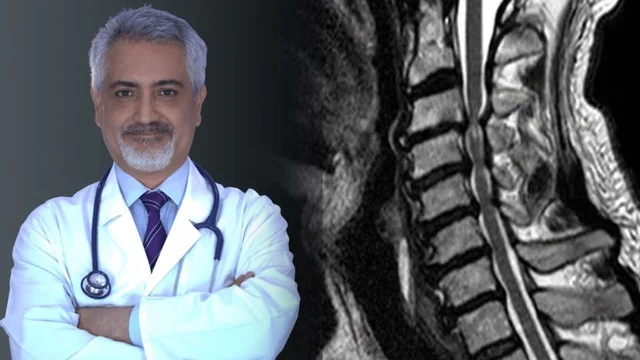
What Is Cervical Spinal Canal Narrowing?
Cervical spinal stenosis is narrowing of the canal through which the spinal cord and nerve roots pass. These structures run through a protected canal at the centre of the vertebrae. Narrowing progresses insidiously over years and begins to mechanically compress the delicate nerve tissue and spinal cord inside.
What Causes Cervical Spinal Canal Narrowing?
The most common cause is advancing age and chronic wear.
- Osteoarthritis and enlargement of the facet joints
- Thickening of ligaments in the canal
- Discs losing integrity and protruding into the canal
- A congenitally narrow canal (symptoms begin earlier in some patients)
What Are the Symptoms of Cervical Spinal Canal Narrowing?
The most typical symptoms are neck and back pain and numbness in the arms.
- Chronic Neck and Back Pain: Pain that becomes established over time and is triggered by movement.
- Morning Stiffness: Starting the day with marked neck stiffness and restricted movement.
- Arm and Hand Numbness: Chronic numbness, tingling and electric sensations due to nerve compression.
- Loss of Motor Skills (Spinal Cord Involvement): Later, difficulty with fine movements such as fastening buttons or writing, unsteady walking, arm and leg weakness and increased reflexes. These indicate spinal cord involvement (cervical myelopathy) and require prompt assessment.
How Is Cervical Spinal Canal Narrowing Diagnosed?
Cervical spinal canal narrowing is recognised through a detailed history and examination; MRI confirms the diagnosis. MRI measures canal diameter in millimetres and assesses spinal cord compression and alignment. CT helps show bony osteoarthritis and spurs more clearly, while EMG helps assess nerve conduction.
How Does Cervical Spinal Canal Narrowing Improve?
Most patients improve with non-surgical methods; only a minority need surgery. Depending on the patient’s condition, care includes non-surgical methods such as medication and physiotherapy, interventional pain treatment or surgery.
1. Conservative (First-Line) Treatments
These are the methods we prefer for early-stage narrowing without neurological damage:
- Medication: Regimens to reduce swelling caused by compression along the nerve pathway.
- Targeted Physiotherapy: Strengthening the muscles around the spine to reduce loading on the narrowed segment.
- Patient Education: Teaching daily movements to adopt or avoid for healthy spinal biomechanics.
2. Interventional Pain Treatments (Algology Procedures)
Because cervical stenosis is chronic, a comprehensive approach is most appropriate. When conservative methods are insufficient, we use the following interventions together in our clinic:
- Cervical Epidural Injection (Targeted Treatment): A medication combination is delivered directly to the epidural area of compression and inflammation, reducing swelling around the nerve and relieving pain.
- Cervical Facet Joint Denervation (Radiofrequency Treatment): When substantial facet degeneration (facet syndrome) accompanies stenosis, radiofrequency blocks nerve transmission in the same session to relieve pain.
These interventions target pain. They do not open mechanical narrowing caused by bone and ligaments, and evidence for their effectiveness in cervical stenosis is limited [6]. They therefore do not replace surgical assessment in patients with progressive weakness.
3. Surgical Methods
Surgery is considered in advanced cases with neurological deficits (weakness), or when non-surgical methods cannot restore quality of life. The operation we most often perform for cervical stenosis is posterior cervical laminectomy with screw fixation:
- Posterior Cervical Laminectomy: From the back of the neck, the bony structures (laminae) compressing the cord posteriorly are removed with microscopic precision, widening the canal and relieving pressure.
- Lateral Mass Screw Fixation (Stabilisation): In patients with vertebral slippage, or an anticipated risk of instability and slippage after laminectomy, screw fixation (instrumentation) is added in the same session to stabilise the spine.
When Is Cervical Spinal Canal Narrowing Operated On?
Surgery is needed when the spinal cord is affected (myelopathy) and weakness begins. The disease is chronic and tends to progress. In our clinic, we carefully determine the boundary between non-surgical care and surgery. Unnecessarily delaying an indicated operation can cause permanent weakness in the arms and legs. An international clinical practice guideline recommends surgery for moderate and severe cord involvement (myelopathy). For mild myelopathy, it advises choosing between surgery and a closely monitored trial of rehabilitation, moving to surgery if deterioration occurs [1]. The two most important outcome factors are myelopathy severity and symptom duration [2, 3]. Delay does not eliminate all chance of recovery: late-presenting patients also benefit from surgery [4]. However, quality-of-life gains are pronounced in patients operated on within two years of symptom onset [5]. Waiting is therefore inappropriate when hand clumsiness or unsteady walking begins.
🩺 Physician’s Insight & Clinical Experience
“When reviewing scans of a patient with stenosis, I focus not only on the bony narrowing but also on the clinical picture. If the narrowing is advanced and hand clumsiness or gait imbalance has begun, delaying surgery is a major mistake. A compressed nerve cell eventually loses its viability, and no matter how much the canal is opened surgically, lost strength may not return.”
Frequently Asked Questions
What Happens If Cervical Stenosis Is Not Treated?
Untreated stenosis does not heal on its own and tends to progress. Chronic nerve pressure can cause wasting of the arm muscles, permanent numbness and marked loss of hand dexterity.
How Effective Are Non-Surgical Methods Such as Epidural Injection and Radiofrequency?
Non-surgical methods are effective in relieving pain in mild and moderate narrowing. Epidural steroid injection reduces inflammation in the nerve roots. When the canal has been completely narrowed by bone and ligament tissue, relief is temporary; surgery is the definitive solution.
At What Stage Is Surgery Needed?
Marked arm weakness, hand clumsiness or unsteady walking indicate that it is time for surgery. Without these signs, surgery is considered when injections fail. The neurological examination and daily limitations matter more to the decision than the MRI image alone.
How Does Cervical Disc Herniation Differ from Stenosis?
A cervical herniation usually begins suddenly and involves soft disc tissue compressing a nerve; it can occur at any age. Stenosis is generally a chronic process over years in people over 50, caused by thickened bone and ligaments. Both can coexist.
Can Stenosis Cause Burning and Numbness in the Arms?
Yes. It causes numbness, tingling and electric-shock sensations in the arms and hands. This indicates nerve pressure; neurological assessment is needed if weakness or impaired hand dexterity accompanies it.
Can an Epidural Steroid Injection Solve Cervical Stenosis?
For pain in many patients, yes; for the narrowing itself, no. By reducing inflammation and swelling around the nerves, injections provide months of relief for many of our patients and help defer surgery. Because they do not open narrowing caused by bone and ligaments, they cannot replace surgery when the spinal cord is affected.
What Is Cervical Myelopathy?
Myelopathy is the set of neurological findings resulting from spinal cord compression. It causes hand clumsiness, loss of fine motor skills, unsteady gait, increased reflexes and, in advanced cases, impaired bladder/bowel control. It describes advanced stenosis directly affecting the spinal cord.
Can Cervical Stenosis Cause Paralysis?
Yes, severe untreated cases can. Neglected cases where arm weakness is not taken seriously may develop permanent nerve-conduction impairment and irreversible walking problems. Early diagnosis and appropriate follow-up substantially reduce this risk.
Does Nucleoplasty Help Cervical Stenosis?
No, nucleoplasty is not the first choice for cervical spinal stenosis. The main problem is thickening of bone and ligaments, whereas nucleoplasty targets disc tissue. Unless a large herniation is also present, we prefer epidural steroid injections in these patients.
Which Doctor Treats Cervical Spinal Canal Narrowing?
Neurosurgery and physical medicine and rehabilitation specialists treat cervical spinal canal narrowing.
Which Specialist Treats Cervical Stenosis in Istanbul?
One of the physicians treating cervical stenosis in Istanbul is M. Levent Deniz, MD, a specialist in neurosurgery.
How Much Does Treatment Cost?
As treatment costs vary according to the patient and hospital conditions, a definite fee can only be determined after examination and review of imaging.
References
- Fehlings MG, Tetreault LA, Riew KD, et al. A Clinical Practice Guideline for the Management of Patients With Degenerative Cervical Myelopathy: Recommendations for Patients With Mild, Moderate, and Severe Disease and Nonmyelopathic Patients With Evidence of Cord Compression. Global Spine J. 2017;7(3 Suppl):70S-83S. PMID: 29164035.
- Tetreault LA, Karpova A, Fehlings MG. Predictors of outcome in patients with degenerative cervical spondylotic myelopathy undergoing surgical treatment: results of a systematic review. Eur Spine J. 2015;24 Suppl 2:236-251. PMID: 23386279.
- Tetreault L, Wilson JR, Kotter MRN, et al. Is Preoperative Duration of Symptoms a Significant Predictor of Functional Outcomes in Patients Undergoing Surgery for the Treatment of Degenerative Cervical Myelopathy? Neurosurgery. 2019;85(5):642-647. PMID: 30445506.
- Asuzu DT, Yun JJ, Alvi MA, et al. Association of ≥12 months of delayed surgical treatment for cervical myelopathy with worsened postoperative outcomes: a multicenter analysis of the Quality Outcomes Database. J Neurosurg Spine. 2022;36(4):568-574. PMID: 34740180.
- Nagoshi N, Yamane J, Okubo T, et al. Impact of Symptom Duration on Surgical Outcomes and Functional Recovery in Degenerative Cervical Myelopathy: Insights from a Prospective Multicenter Study. Spine (Phila Pa 1976). 2026;51(16):1123-1129. PMID: 40981281.
- American Academy of Neurology Guidelines Subcommittee. Epidural Steroids for Cervical and Lumbar Radicular Pain and Spinal Stenosis Systematic Review Summary: Report of the AAN Guidelines Subcommittee. Neurology. 2025. PMID: 39938000.
- 👨⚕️ Author and medical reviewer of this content: M. Levent Deniz, MD – Neurosurgery Specialist
- ⚠️ Medical Disclaimer: This page is for information only; consult your doctor for diagnosis and treatment.
Appointments & practical information
How do I book an appointment?
You can send your appointment request via WhatsApp, by phone or through the contact form. Briefly describing your complaint and the times that suit you speeds things up; we respond as quickly as possible.
What should you bring to the consultation?
If available, bring your recent MRI and CT images, previous test and surgery reports, and a list of the medication you take regularly. This makes the assessment considerably easier.
What happens at the first consultation?
We listen to your complaints and history, perform a neurological examination and review your existing images together. Treatment options are then planned with you, taking your expectations and lifestyle into account.
Second opinion
If you have been diagnosed or advised to have surgery elsewhere, you can book an appointment for a second opinion with your existing images and reports.
Reach out for your questions and appointment requests. We reply as soon as possible.
Book Appointment